




Your brakes are the single most important safety system on your vehicle. Every time you press that pedal, you're trusting a carefully engineered set of components to bring thousands of pounds of metal to a controlled stop — sometimes in a fraction of a second. Yet brake maintenance is one of the most commonly delayed services drivers in Fort Myers put off, often because they're not sure when it's truly necessary or what the real consequences of waiting can be.
At Lou's Total Car Care on South Cleveland Avenue, our team sees brake-related issues every single day. Some are caught early during routine inspections and resolved quickly and affordably. Others have been ignored for so long that what started as a simple brake pad replacement has turned into a full brake system overhaul. Understanding what actually happens inside your braking system when maintenance is neglected can save you serious money — and potentially your life.
How Your Brakes Actually Work
Before diving into what happens when brakes go bad, it helps to understand the basics of how they function. Most modern vehicles use disc brakes on all four wheels, though some still use drum brakes in the rear. In a disc brake system, a set of brake pads clamps down on a spinning rotor whenever you press the pedal. The friction created by that contact is what slows and stops your vehicle.
Brake pads are designed with a specific thickness of friction material. Over time, as that material wears down through repeated use, the pad becomes thinner and less effective. Most pads include a small metal wear indicator — essentially a tab that begins to make contact with the rotor when the pad reaches a critically low thickness. That's what creates that familiar squealing sound you may have heard from vehicles around you, or possibly your own.
The Role of Brake Fluid
Many drivers overlook the fact that their braking system is hydraulic. When you press the brake pedal, brake fluid transmits that force through the brake lines to the calipers, which then squeeze the pads against the rotors. Brake fluid is hygroscopic, meaning it absorbs moisture from the air over time. As moisture content increases, the fluid's boiling point drops, which can lead to reduced braking performance — especially during heavy or repeated braking situations. In Florida's humid climate, this process happens faster than in drier regions of the country.
What Happens When You Ignore Worn Brakes
This is where delayed maintenance becomes genuinely dangerous and expensive. The deterioration of a neglected brake system doesn't happen all at once — it progresses in stages, with each stage more severe and more costly than the last.
Stage One: Worn Brake Pads
This is the earliest and most affordable stage to address. Worn brake pads can typically be replaced quickly and without replacing any other components. At this point, you may notice mild squealing, slightly longer stopping distances, or a subtle vibration in the pedal. Addressing the problem here keeps costs low and your vehicle safe.
Stage Two: Rotor Damage
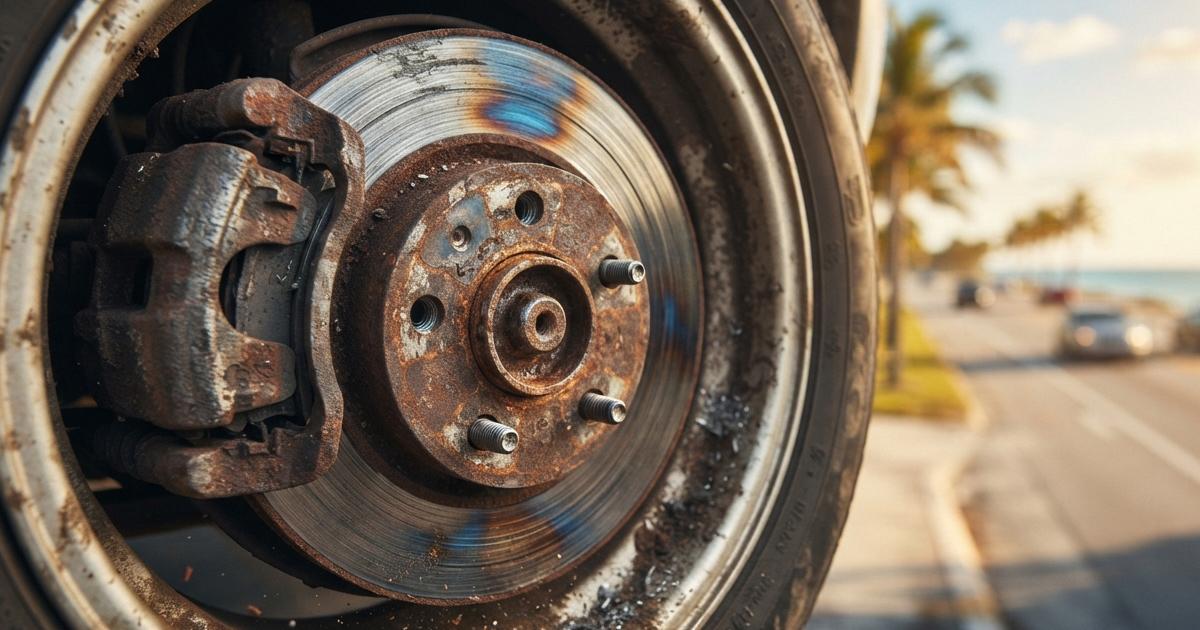
If worn pads are ignored, the metal backing plate of the pad eventually contacts the rotor directly. This is called metal-on-metal contact, and it causes deep scoring and grooving in the rotor surface. Rotors that have been scored this way cannot be resurfaced — they must be replaced. A simple brake pad replacement that might have cost a fraction of the price now includes the cost of new rotors as well. You'll often hear a harsh grinding or scraping sound at this stage, and stopping distances will increase noticeably.
Stage Three: Caliper and Hardware Damage
If even rotor damage goes unaddressed, the wear can progress to the brake calipers themselves. Calipers are significantly more expensive than pads or rotors, and damaged calipers can cause uneven braking, pulling to one side, and in extreme cases, brake failure. At this stage, the repair cost can be several times higher than what it would have been at stage one.
Stage Four: Total Brake System Compromise
In the most severe cases of neglect, overheated brake fluid, seized calipers, warped rotors, and completely consumed pads can compromise the entire system. Brake failure — the inability to stop — becomes a real possibility. This is not just a financial crisis; it is a life-threatening situation.
Warning Signs You Should Never Ignore
Lou's Total Car Care wants every Fort Myers driver to know the warning signs that indicate your brakes need professional attention. Don't wait for the problem to escalate. Bring your vehicle in if you experience any of the following:
- Squealing or screeching sounds when applying the brakes — this is typically the wear indicator doing its job and telling you it's time for new pads
- Grinding or metal-on-metal scraping — this means the pads are fully worn and rotor damage is likely already occurring
- Vibration or pulsing in the brake pedal — this often indicates warped rotors caused by excessive heat
- The vehicle pulling to one side when braking — this can indicate a seized caliper or uneven pad wear
- A soft or spongy brake pedal — this is often a sign of air in the brake lines or degraded brake fluid
- Longer stopping distances than you're used to — your vehicle simply isn't slowing down as quickly as it should
- The brake warning light illuminating on your dashboard — never ignore a lit brake light, even if everything else feels fine
Why Southwest Florida Driving Is Especially Hard on Brakes
Fort Myers drivers deal with a unique combination of conditions that can accelerate brake wear. Stop-and-go traffic on US-41, Daniels Parkway, and Colonial Boulevard creates repeated braking cycles that generate heat and wear pads faster than highway driving. Florida's humidity accelerates brake fluid moisture absorption. Coastal air introduces salt and moisture into brake components, increasing the risk of corrosion on rotors and caliper hardware. And the intense heat of Southwest Florida means brake components are already operating in an elevated temperature environment before you even begin driving.
All of these factors make it especially important for Fort Myers drivers to stay proactive about brake inspections and not rely solely on mileage intervals used by drivers in cooler, less humid parts of the country.
The Smart Approach: Routine Brake Inspections at Lou's Total Car Care
The most effective way to avoid a costly or dangerous brake situation is to have your brakes inspected regularly by a trusted local shop. At Lou's Total Car Care, brake inspections are part of our comprehensive vehicle check process. Our technicians measure pad thickness, inspect rotor condition, check caliper function, test brake fluid quality, and examine all related hardware to give you a complete picture of where your braking system stands.
We believe in honest assessments. If your brakes are in great shape, we'll tell you that. If they're approaching the point where service will be needed soon, we'll let you know so you can plan ahead. And if there's an issue that needs immediate attention, we'll explain it clearly and give you fair, transparent pricing before any work begins.
Fort Myers families deserve a shop they can trust with something as important as brake safety. Lou's Total Car Care has been serving this community with that commitment in mind. Give us a call at (239) 278-1682 or stop by our shop at 4531 S Cleveland Ave, Fort Myers, FL 33907. Your safety on Southwest Florida's roads starts with brakes you can count on — and a team you can trust to take care of them the right way.